“By making prosphora with your hands, and unceasing psalmody with your lips, you offered a sacrifice of praise to the Lord, together with the honorable Νikόdēmos. O blessed Spyridon, with him entreat Christ God for our souls.”
Join us as we celebrate the art of bread baking!
Christ the Saviour Church is an Orthodox Christian mission located in Amherst, Virginia. Currently we’re hosting services at Second Stage Arts & Community Center located at 194 Second Street, Amherst, VA 24521. We’re under the jurisdiction of the Orthodox Church in America (OCA) and are mission effort of St. Cyprian of Carthage Orthodox Church in Richmond.
Welcome! Have a seat and let’s get baking!
Class Schedule
| 2:30 - 3:00 PM | Check-in, refreshments, and find a seat. |
| 3:00 - 3:15 PM | Welcome & Introduction |
| 3:15 - 4:30 PM | Baking and Demonstration |
| 4:30 - 5:00 PM | Q & A - Time to ask your questions. |
Class Introduction
Every Second Sunday of Lent the Orthodox Church celebrates the lives of the Venerable Fathers of the Kiev Caves Lavra (a type of monastery founded in the 11th century in what is now Ukraine). Two such men from this monastery, Ss. Spyridon and Nikodemos are remembered as men who baked prosphora for over thirty years while continuously praying and singing songs.
This year the 2nd Week of Lent begins on March 8th and we felt it a great way to mark the occasion with a celebration of the rich history of baking in the Orthodox Church.
If you enjoy baking, hearing about history or theology, or just like learning new things, we welcome you to participate! The RSVP form is below. Please do so by March 1st so we can have sufficient material available for everyone.
A Look at the Baking Process
First, we start with prayer.
Here’s an example of a prayer from this step.
O God, our God, You sent the heavenly Bread, the food for the whole world, our Lord and God Jesus Christ, as Saviour, Redeemer and Benefactor to bless us and sanctify us. Do bless this offering and accept it upon Your heavenly altar. As a good and loving God, remember those who brought it and those for whom it was brought. Keep us blameless in the celebration of Your divine Mysteries. For sanctified and glorified is Your most honorable and majestic name, of the Father and the Son and the Holy Spirit. Amen.
Then we’ll review our ingredients (flour, water, starter, etc.) and begin mixing.
After that, we are kneading, shaping, and letting the bread proof.
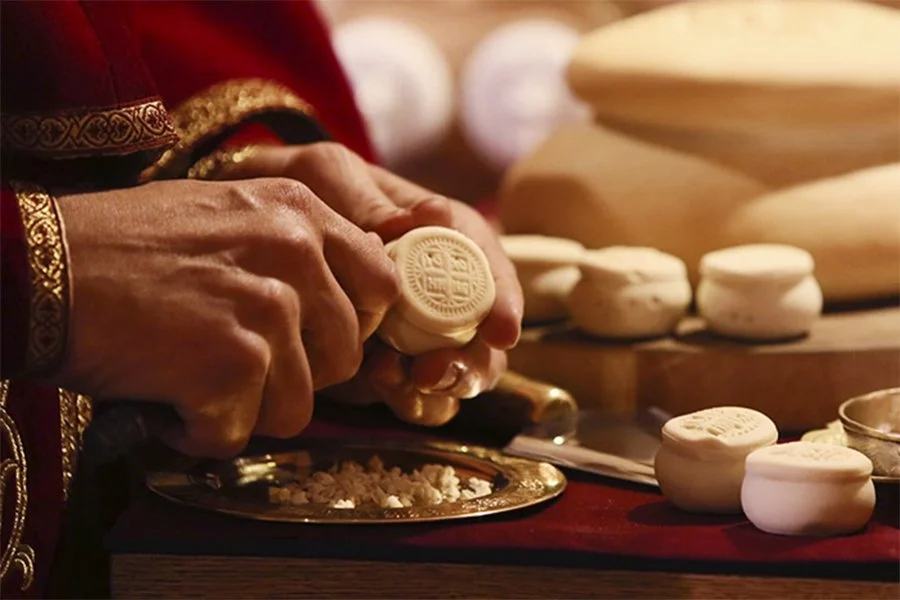
Once ready, we stamp and bake.
As the loaves cool, we will have a short Q&A session.
RSVP
Frequently Asked Questions (FAQ)
-
Great question. See the above section labeled “Class Schedule” for a complete explanation of the course.
But, in general, we’ll be making bread and talking about the history and theology of making prosphora.
-
Saints Spyridon and Νikόdēmos, the Prosphora-bakers of the Kiev Caves fulfilled their obedience of baking prosphora for thirty years. Saint Spyridon came to the monastery in the time of Igoumen Pimen (1132-1141), when he was no longer a young man. He was illiterate, but knew the entire Psalter by heart. The ascetic combined his work with unceasing prayer and chanting all the Psalms every day. Even during his lifetime Saint Spyridon was glorified by miracles.
Once, his mantiya caught fire from the stove. The fire was extinguished, but his mantiya remained whole. Saint Νikόdēmos labored with Saint Spyridon and led a very strict life. Their relics are in the Near Caves of Saint Anthony. The fingers of Saint Spyridon’s right hand are positioned to make the Sign of the Cross with three fingers.
Saints Spyridon and Νikόdēmos are also commemorated on August 28 (Synaxis of the Saints of the far Caves of Saint Theodosios), September 28 (Synaxis of the Saints of the Near Caves of Saint Anthony), and on the second Sunday of Great Lent (Synaxis of all the Venerable Fathers of the Kiev Caves).
-
Prosphora is the name given to the loaves of bread offered during Divine Liturgy in the Orthodox Church.
Each individual loaf is referred to as a prosphoron or – in everyday Russian – a prosforka.
The name comes from a Greek word that simply means “an offering”. In the Slavic tradition the loaves are customarily small – around 2¼ inches diameter – and made in two parts. In other Orthodox traditions the loaves are generally larger with a more elaborate seal. These two parts represent the two natures of Jesus Christ, divine and human.
Before baking, the top of each loaf is stamped with a seal that includes a cross and the letters IC-XC NIKA, meaning “Jesus Christ conquers”.
-
Christ the Saviour is offering this class for free. Donations are of course appreciated, but not at all required.
If you’re interested in donating, there will be an opportunity at the event.